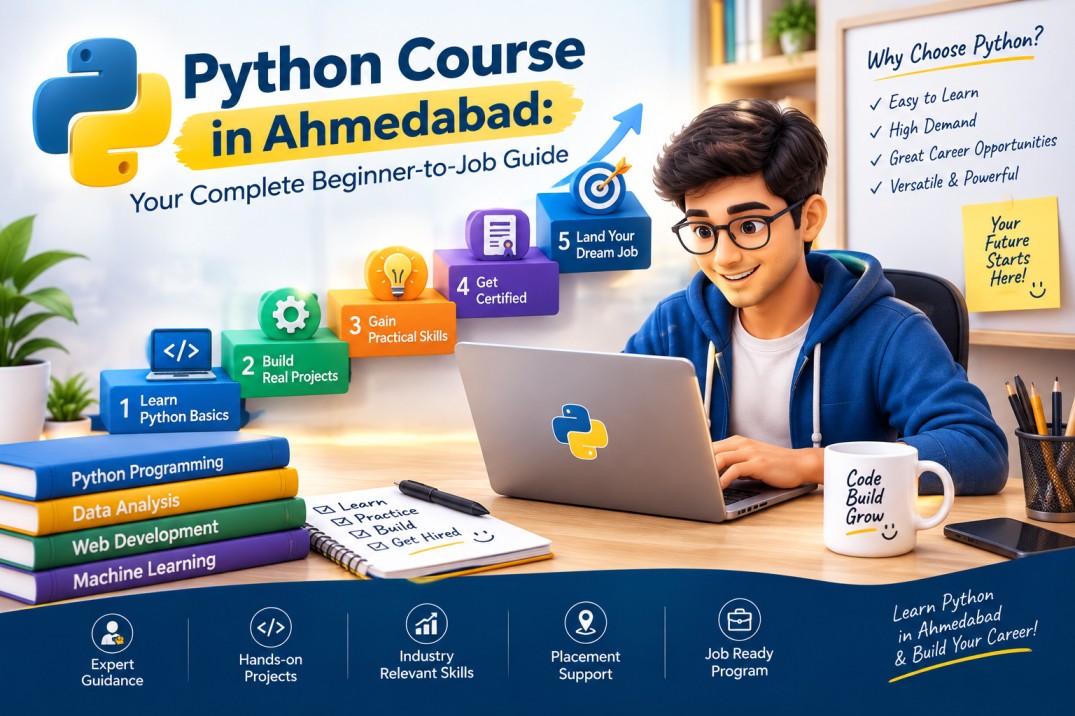
Python Course in Ahmedabad: Your Complete Beginner-to-Job Guide
Python has become the starting point for millions of tech careers, and for good reason. It's beginner-friendly, incredibly versatile, and powers everything from web applications to data science and automation. If you're exploring a Python course in Ahmedabad, this guide walks you through eligibility, syllabus, course duration, beginner projects, career scope, and how to choose a program that actually gets you job-ready, not just certificate-ready.
Why Python Is the Smartest Language to Learn Right Now
Unlike many programming languages that demand prior coding experience, Python's simple, readable syntax makes it one of the most accessible entry points into tech. But don't mistake "beginner-friendly" for "limited." Python powers everything from Django-based web applications to machine learning models, automation scripts, and full data science pipelines.
At IDSL Academy, we've trained students from completely non-technical backgrounds into confident Python developers, and the pattern is consistent: structured, project-based learning beats passive video-watching every time. If you're still deciding whether Python is right for you, our post on the benefits of learning Python and our list of 10 reasons to learn Python can help.
Eligibility for a Python Course in Ahmedabad
One of Python's biggest advantages is accessibility. Typical eligibility includes:
-
Educational background: 10+2 or a bachelor's degree in any stream. A computer science background helps but isn't mandatory.
-
No prior coding experience required for a Python course for beginners in Ahmedabad.
-
Working professionals from non-tech backgrounds looking to move into development, data analysis, or automation roles.
-
Students and graduates wanting to add a high-demand skill to their resume before entering the job market.
Whether you're starting from zero or already know the basics, there's usually a path suited to your level, from foundational Python classes in Ahmedabad to advanced, project-heavy programs.
Python Course Syllabus: What You'll Actually Learn
A well-structured Python course syllabus should cover far more than basic syntax:
1. Python Fundamentals Variables, data types, loops, functions, and control structures: the foundation every Python developer needs before moving further.
2. Object-Oriented Programming (OOP) Understanding classes, objects, and OOP principles, which are essential for writing scalable, maintainable code.
3. Python Libraries (NumPy, Pandas) Hands-on training with NumPy and Pandas for data manipulation and analysis, core tools for anyone pursuing Python for data science.
4. Web Development with Django Learning the Django framework to build real, functional web applications, a key skill for full stack Python development roles.
5. Automation & Scripting Using Python for automation to handle repetitive tasks, file processing, and workflow automation. This skill is increasingly valued across industries, not just in pure development roles.
6. Real-World Projects A strong program emphasizes project-based learning: building actual applications, not just completing isolated exercises, so you graduate with a portfolio, not just a certificate.
Python Course Duration: How Long Does It Take to Learn Python?
"How long is a Python course?" is one of the most common questions beginners ask, and the honest answer is that it depends on what you want to achieve. Here is a realistic way to think about it:
-
Python basics (foundation level): Enough to understand syntax, write small programs, and solve simple problems. This stage is the shortest.
-
Intermediate Python with libraries and OOP: Adds object-oriented programming, NumPy, Pandas, and file handling. This takes noticeably longer than the basics alone.
-
Job-ready Python (web development, data, or automation): Adds Django or data analysis, plus real projects and interview preparation. This is the longest track, but it's the one that actually prepares you for employment.
What Affects Python Course Duration?
-
Your starting point: Complete beginners need more time than students who already know another language.
-
Learning pace and consistency: Practicing a little every day usually beats cramming once a week.
-
Class format: Daily batches move faster than weekend-only schedules.
-
Course depth: A basics-only course is shorter than a program that includes Django, data analysis, and projects.
-
Practice outside class: Time spent building projects on your own can shorten your path to confidence.
Be cautious of very short "learn Python in a few days" promises. They may cover syntax, but they rarely leave you ready for interviews or real projects. At IDSL Academy, the exact duration depends on the track and batch you choose, so book a free demo session to get the current schedule and recommended learning path for your goals.
Practical Python Projects for Beginners
Projects are where learning becomes real. Reading about loops is easy; building something that uses them teaches you far more. Here are beginner-friendly Python projects worth building, grouped by the skills they develop.
Starter Projects (Fundamentals)
-
Number guessing game: Practices loops, conditions, and user input.
-
Simple calculator: Practices functions and basic error handling.
-
Password generator: Introduces random selection and string handling.
-
To-do list (command line): Practices lists, dictionaries, and file saving.
Intermediate Projects (OOP and Data)
-
Expense tracker: Combines OOP, file handling, and basic reporting.
-
Quiz application: Practices classes, scoring logic, and data structures.
-
Data analysis on a CSV file: Uses Pandas to clean, filter, and summarize real data.
-
Simple data visualization: Turns a dataset into charts to spot patterns.
Job-Ready Projects (Web and Automation)
-
Blog or portfolio website with Django: Covers models, views, templates, and databases.
-
Web scraper: Collects data from web pages automatically.
-
File organizer script: Sorts files into folders using automation.
-
Weather app using an API: Teaches how to work with external data sources.
Why Projects Matter for Your Career
Employers rarely care only about certificates. A small portfolio of working projects, ideally hosted on GitHub, shows that you can apply what you've learned. This is why we emphasize project-based learning in our training. Aim to finish at least one project from each level above before you start applying for jobs.
Career Scope After Learning Python
This is often the deciding factor for students, and rightly so. Python's career scope is wide because the language is used across so many fields. Python developer salary and demand vary by role, experience, and company, but the options below remain strong paths for beginners who build real skills.
Popular Career Paths
-
Python Developer: Building web applications and backend systems.
-
Data Analyst: Using Python, Pandas, and visualization tools to turn data into insights.
-
Data Scientist: Applying statistics and machine learning to larger datasets (usually with further specialization).
-
Automation Engineer: Scripting workflows and eliminating repetitive manual work.
-
Machine Learning Engineer: Building and training ML models (with further specialization).
-
Full Stack Developer: Combining Python backend skills with frontend technologies.
-
QA and Test Automation Engineer: Using Python to write automated tests.
Where Python Professionals Work
Python skills are used across startups, IT services companies, product companies, finance, healthcare, education, and e-commerce. Many professionals also build careers through freelancing and remote work, since Python projects are easy to deliver independently.
How to Improve Your Job Prospects
-
Build and publish a project portfolio on GitHub.
-
Learn one specialization well (web, data, or automation) rather than skimming everything.
-
Practice coding problems and mock interviews regularly.
-
Pair Python with complementary skills like SQL, Git, and frontend basics.
To understand how Python compares with other development roles, see our guide on the job of a web developer in India. Unsure which language to start with? Read what programming language you should learn.
How to Choose the Best Python Training Institute in Ahmedabad
Not all Python programs are created equal. When evaluating a Python training institute in Ahmedabad, look for:
-
Project-based learning rather than purely theoretical lectures
-
Industry-relevant curriculum covering web development, data science, and automation, not just basic syntax
-
Experienced trainers with real development or data science backgrounds
-
Placement assistance and portfolio-building support
-
Updated syllabus reflecting current tools and frameworks, not outdated material
This is exactly the approach we've built our training around at IDSL Academy's Python Programming Course, combining structured fundamentals with hands-on projects so students graduate genuinely employable, not just certified.
Pairing Python With Other In-Demand Skills
Many of our students choose to pair their Python course with complementary skills for broader career opportunities. If you're interested in web development specifically, our Full Stack Web Development Course builds on Python fundamentals with frontend and backend integration. For students interested in security-focused roles, our Cyber Security Course is another strong complementary skill path.
Why Learn Python With IDSL Academy
Learn more about our training philosophy and what sets our approach apart: practical, project-driven learning led by experienced instructors. You can also meet the industry experts leading our training programs to see the real-world experience behind our curriculum.
Frequently Asked Questions About Python Course in Ahmedabad
Is Python suitable for beginners with no coding experience?
Yes. Python's simple syntax makes it one of the easiest languages to start with, and no prior coding experience is needed.
What is the fee for a Python course in Ahmedabad?
Fees depend on course depth, duration, and what's included. For current fees and payment options at IDSL Academy, book a free demo.
How long does it take to learn Python?
Basics come quickly, but becoming job-ready with Django, data libraries, and projects takes longer. Your pace and consistent practice make the biggest difference.
What are the eligibility criteria for a Python course?
A 10+2 or any bachelor's degree is usually enough. A computer science background helps but isn't required.
What jobs can I get after learning Python?
Python Developer, Data Analyst, Automation Engineer, Full Stack Developer, and QA Automation roles are common starting points.
Does IDSL Academy provide practical projects and placement assistance?
Yes. Our training is project-based, and we offer job assistance and career guidance. Contact us for current placement details.
Which is better for beginners: Python or Java?
Python is easier to start with thanks to its simpler syntax. Java suits enterprise and Android development but has a steeper start. See which language to learn.
Final Thoughts
A Python course in Ahmedabad can genuinely be the starting point of a strong tech career, but only if the training goes beyond syntax and into real, applied projects. Understand how long the learning path takes, build projects that prove your skills, and choose a program that supports you through to the job search.
Ready to start your Python journey? Book your free demo session today and take the first step toward a rewarding tech career with IDSL Academy.